Reeftrack
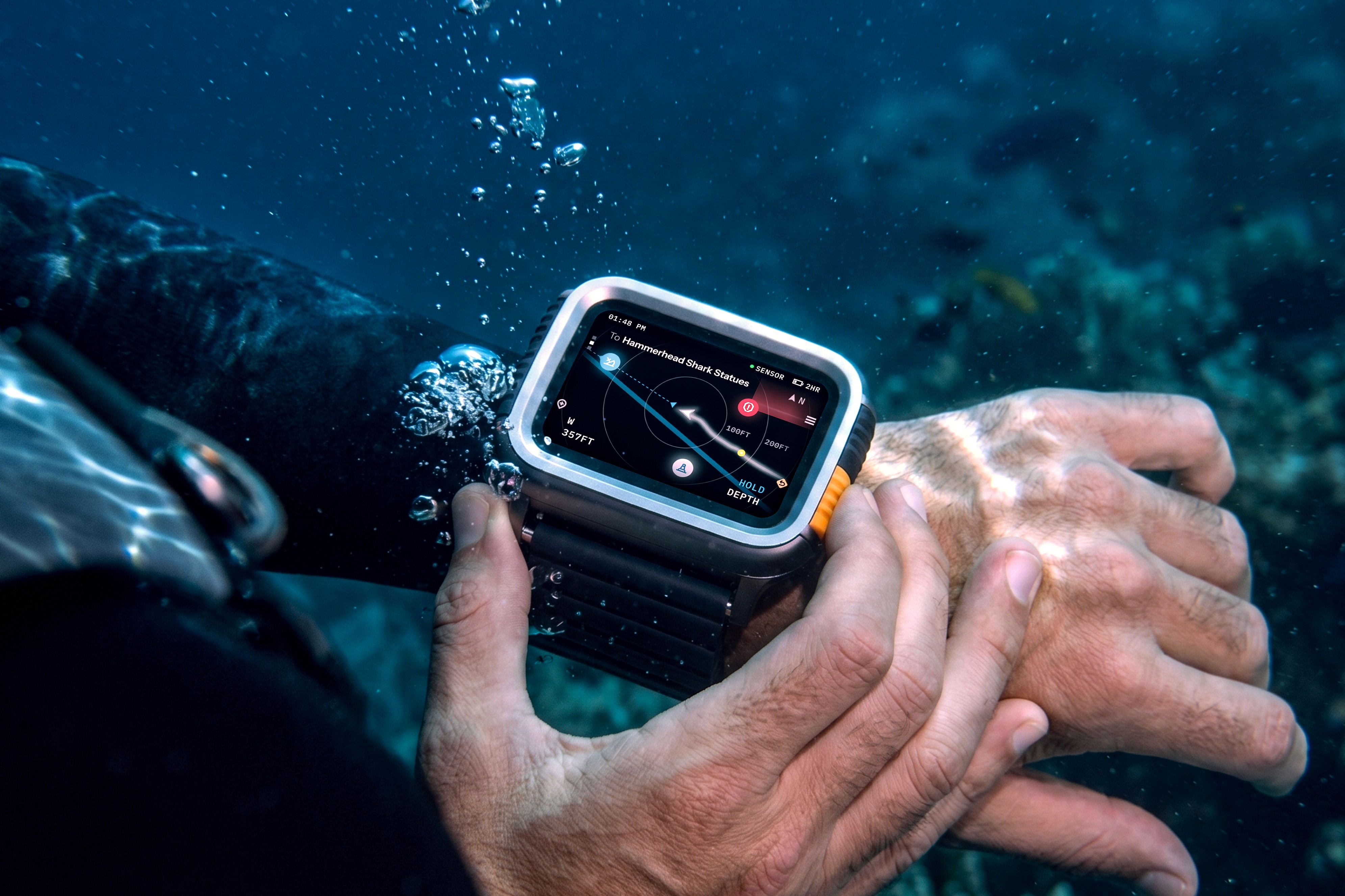
A connected dive system that brings navigation, route sharing, and live tracking to recreational divers.
What I did
UX lead — digital strategy, wearable interface, functional app build
Team
Experience design
1 Design Manager
2 UX Designers (me)
2 Design Strategists
Industrial design
3 Industrial Designers
Time
3 months
Opportunity
For recreational divers, underwater navigation is an unsolved problem. GPS doesn't work below the surface, so divers rely on memory, a compass, or following a guide. Getting lost underwater is a real risk.
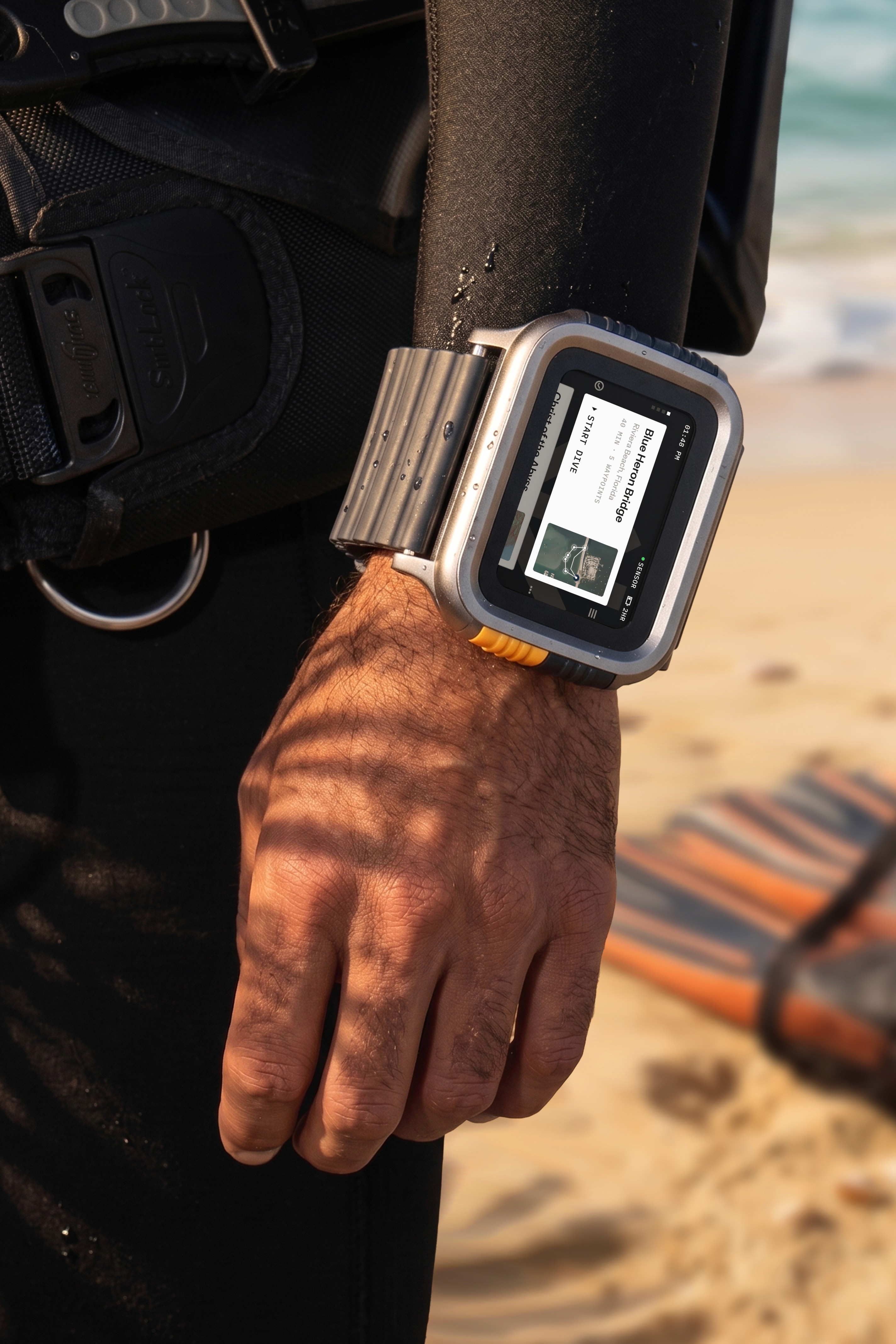
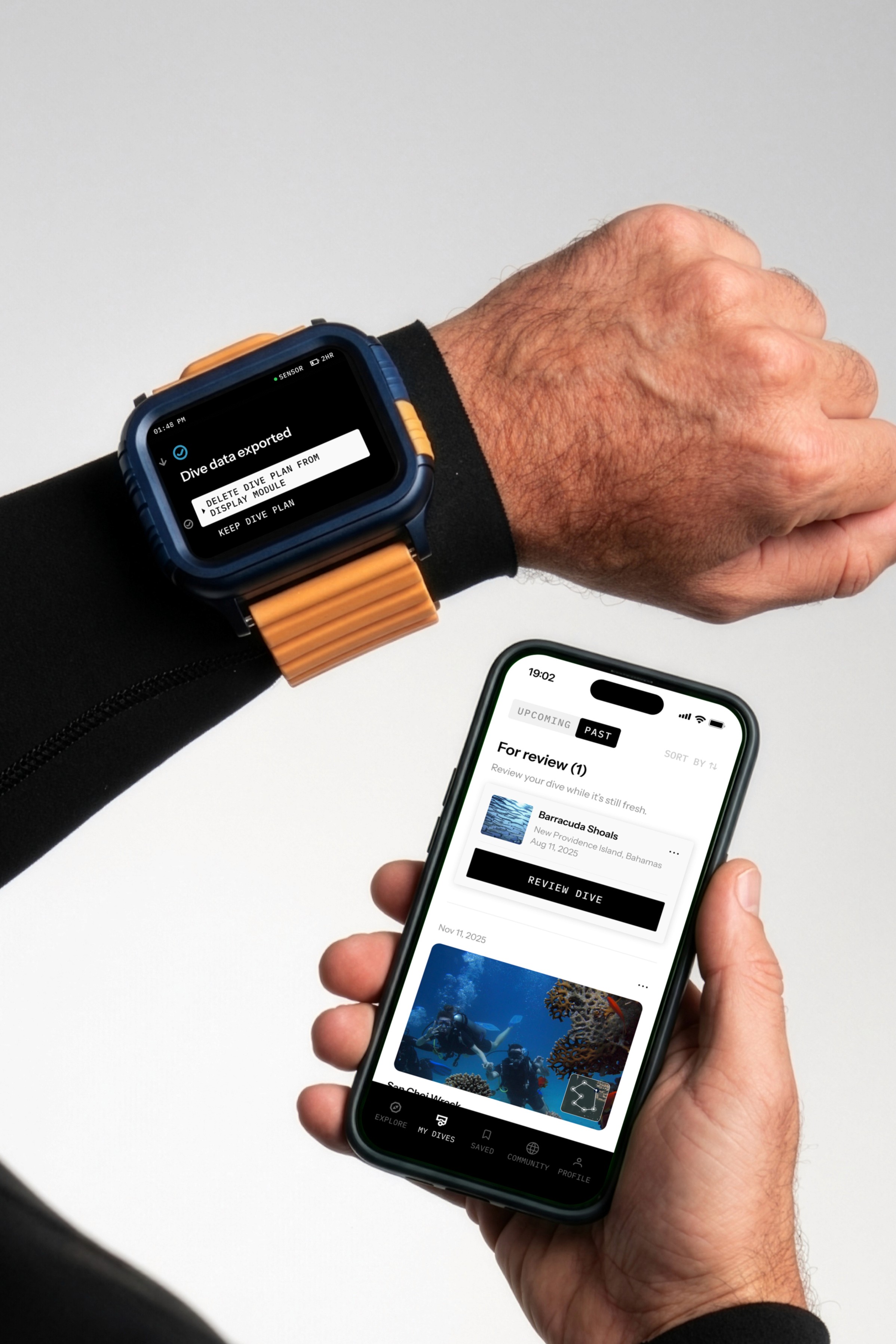
Trident Motion invented proprietary technology to make real-time underwater navigation work, and had a vision for a product ecosystem that covered the whole diver journey: planning before the dive, navigation during it, reflection and social after. We had three months to design and prototype the full system, including mobile app, wrist navigator, and vest sensor, for a working demo at DEMA, the dive industry's leading trade show.
Design Process Highlights
Finding the MVP
Trident Motion's vision spanned the full diver journey. Since we had three months to ship a working prototype, the first thing to figure out was which features to prioritize for the initial demo.
Working with the strategy team, we synthesized research into three product principles: confidence, presence, community. I translated those into design implications and used them to inform scoping. Working from a feature map I built around the diver's journey, the team and I cut the spec down to a core MVP set focused on features that delivered clarity and reliability underwater, kept attention on the world rather than the tool, and connected divers to the broader dive community.
UX across digital and physical
The diver experiences the wearable as a single product, even though it has two elements: the screen they look at, and the four buttons they press. Designing the wearable's UX meant designing both elements as one interaction, so that the wearable felt seamless to use underwater.
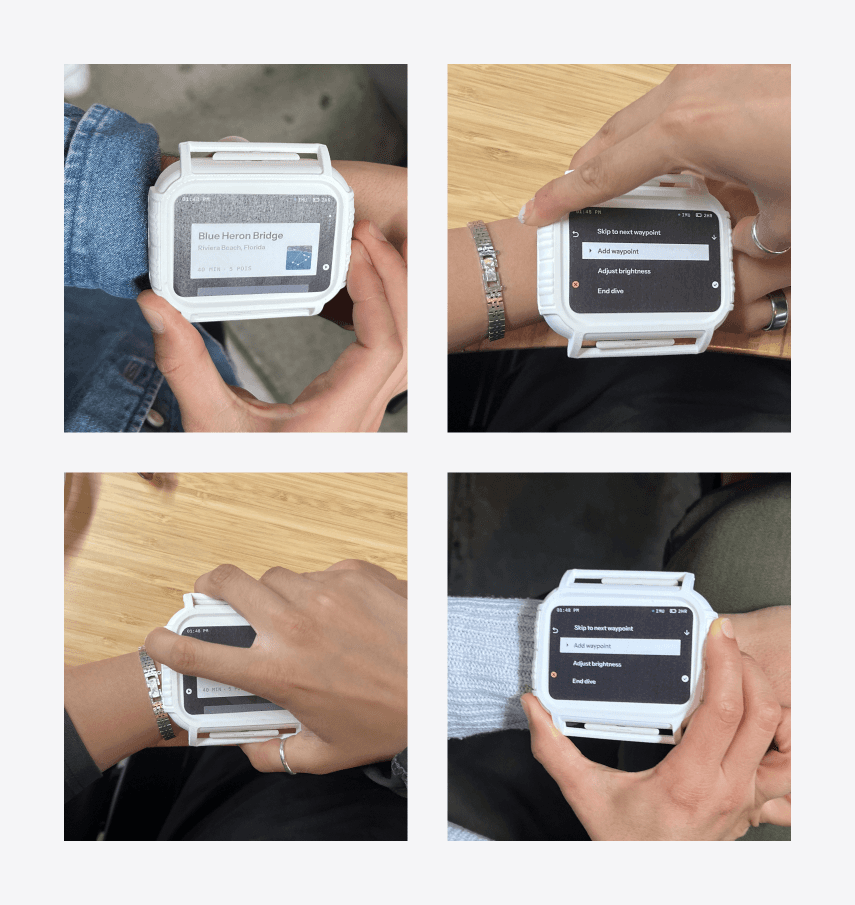
Beyond visual coherence, where I designed typography, color, and components that felt continuous with the device's form and CMF, the deeper work was making the interaction itself feel cohesive. I ran a study of users interacting with the buttons on the 3D-printed physical device to find the buttons that were most consistently reachable, and assigned functions to those positions accordingly. Safety came first, so the emergency button took the most accessible position, and I placed the other most frequent actions where the diver's fingers could reach most easily. In addition, because each button's function changes depending on the screen state, I created an on-screen visual feature where a legible icon is placed directly adjacent to each physical button to indicate its current function, so the diver always knows what each one is doing without having to remember mappings.

A prototype that behaved like a product
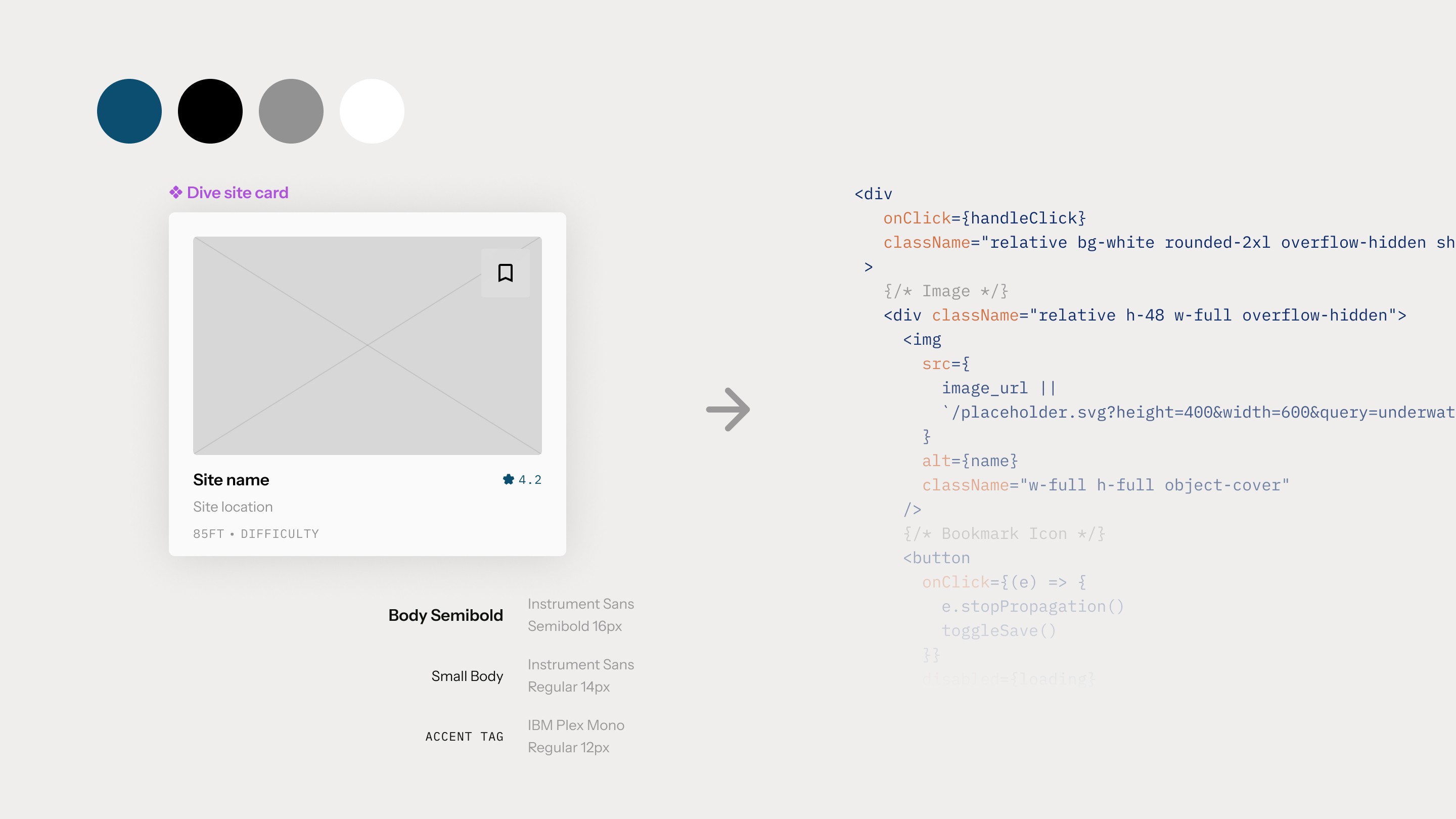
The phone app’s value lived in dynamic features such as 3D underwater terrain that users could rotate and explore, live weather data tied to specific dive sites, and persistent waypoints and routes. To let users experience the full product at DEMA, instead of a Figma clickable prototype that could only simulate the look of those features, I built a functional web app with a live database and full visual branding, solo, in three weeks. The app loaded onto an iPhone at the booth, and while the client ran the booth in Florida, I pushed bug fixes remotely from San Francisco as issues came in.
Building real rather than faked changed what the prototype could do. Attendees used it as a actual product rather than a demo. They picked it up and started planning dives with minimal guidance rather than being walked through a scripted flow. Instead of troubleshooting the prototype itself, like calling out broken interactions and missing screens, they started reacting to the product, talking about the value it created for them and asking for new features like waypoint search and entry/exit tagging.
The build also surfaced design issues earlier than static mockups would have, since navigation problems, state gaps, and interaction friction all became visible the moment the app was live, which meant the prototype became a design tool as much as a deliverable. And because the working app already used real APIs, a real database, and a real component system, it gave the eventual development team a concrete reference point rather than just a spec to interpret.
I wrote about the build process here and about how AI-assisted prototyping changes user feedback here.

Outcome
The full system shipped to DEMA in three months. The functional prototype held up under sustained use on the floor, where attendees used it as a product rather than a demo. ReefTrack is now in preorder at reeftrack.com, with email signups arriving every twenty minutes during launch weekend from divers across nine countries. Organic coverage followed in dive media, and the project drew genuine interest from established players in the dive industry.

